


 English
 Español
 عربى
عربى
 中文简体
中文简体




+86-180 3665 1199
Content
Direct Answer
Sound absorbing panels reduce echo, reverberation, and noise reflections inside a room. They do not block sound from entering or leaving — but placed correctly, they dramatically improve acoustic clarity and comfort in any space.
01
What Are Sound Absorbing Wall Panels?
Sound absorbing wall panels are acoustic treatment materials mounted on walls (and sometimes ceilings) to reduce the amount of sound energy that bounces around a room. Unlike hard surfaces such as concrete, glass, or drywall — which reflect up to 99% of sound — acoustic panels convert that energy into a small amount of heat through friction within their porous or fibrous structure.
Most panels fall into one of three material categories:
Fiberglass / Rockwool
The most effective and widely used core material. Dense fiberglass boards (e.g., Owens Corning 703) absorb mid and high frequencies with a Noise Reduction Coefficient (NRC) of up to 0.95 — meaning 95% of sound energy is absorbed.
Melamine Foam
Lightweight open-cell foam panels. Effective at high frequencies but noticeably weaker below 500 Hz. NRC typically ranges from 0.60 to 0.80 depending on thickness.
Fabric-Wrapped Panels
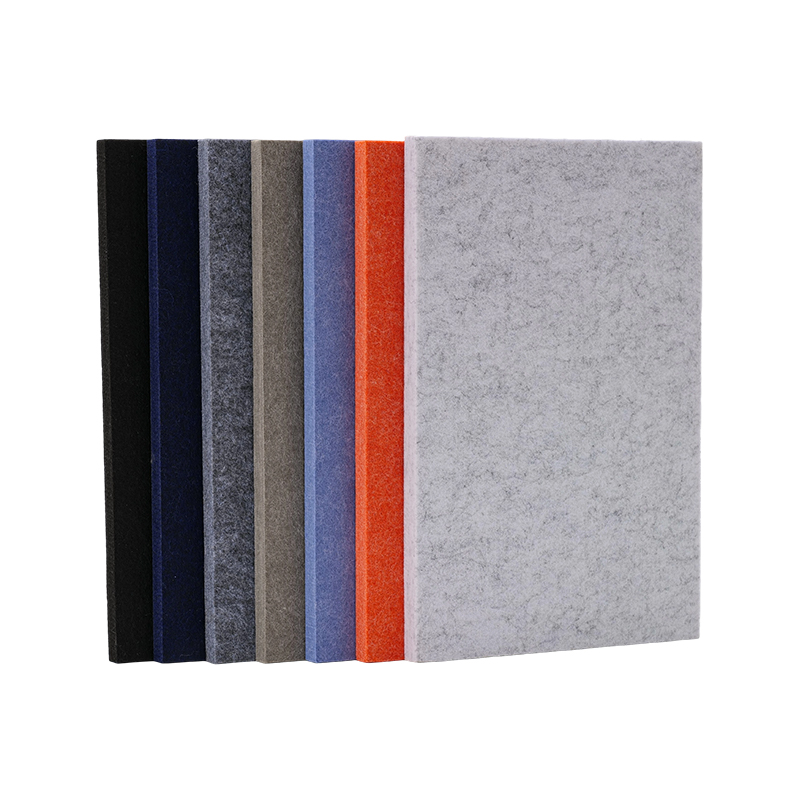
Decorative panels with a rigid acoustic core wrapped in acoustic fabric. Common in offices, home theaters, and studios. Combine functionality with aesthetics, NRC 0.75–0.95.
Thickness matters significantly. A 1-inch panel absorbs primarily above 1,000 Hz. A 4-inch panel begins absorbing effectively down to 250 Hz — capturing more of the human voice and musical bass range.
02
Do Sound Absorbing Panels Actually Work?
Yes — with an important qualification. Acoustic panels are highly effective at controlling reverberation time (RT60), which is the time it takes for sound to decay by 60 dB after a source stops. In an untreated room, RT60 can exceed 1.5–2 seconds, causing a muddy, echoey sound. In a properly treated room, RT60 drops to 0.3–0.5 seconds, resulting in clear, intelligible audio.
| Room Type | Ideal RT60 Target | Panels Needed (approx.) |
|---|---|---|
| Recording Studio (vocal booth) | 0.2 – 0.4 sec | 50–70% wall coverage |
| Home Theater | 0.3 – 0.5 sec | 30–50% wall coverage |
| Podcast / Streaming Room | 0.3 – 0.5 sec | 25–40% wall coverage |
| Open-plan Office | 0.5 – 0.8 sec | 15–25% wall coverage |
| Conference Room | 0.6 – 0.8 sec | 20–35% wall coverage |
A real-world example: A standard 12×12 ft bedroom with hard floors and bare walls may have RT60 of 1.8 seconds. Adding six 24×48 inch, 2-inch fiberglass panels to the walls can reduce RT60 to approximately 0.6 seconds — a 67% improvement that is clearly audible in recordings and calls.
03
How to Place Sound Absorbing Panels for Best Results
Placement is as critical as material choice. Placing panels randomly will underdeliver. Follow these positioning principles:
A
Identify Reflection Points (Mirror Trick)
Sit in your listening or recording position. Have a helper slide a mirror along the side wall. Wherever you can see a speaker or sound source in the mirror, place a panel. These are your first-order reflection points — the most damaging for clarity.
B
Treat Corners with Bass Traps
Low-frequency energy accumulates in corners. Floor-to-ceiling corner bass traps (typically 4-inch thick fiberglass or rockwool) reduce low-end buildup. Even small rooms benefit from treating at least two front corners.
C
Distribute Coverage Evenly
Avoid clustering all panels on one wall. Uneven treatment creates an acoustically "dead" side and a live side, which skews the sound image. Distribute panels symmetrically across opposite walls wherever possible.
D
Use the Ceiling — Especially Above the Mix Position
A cloud panel (horizontal panel overhead) at the primary listening or recording position absorbs direct ceiling reflections. Studies show that ceiling treatment can reduce RT60 by an additional 15–20% beyond wall treatment alone.
E
Leave Some Surfaces Untreated
A completely dead room feels unnatural and fatiguing. Aim for a balanced ratio — leave 50–70% of surface area untreated, using diffusers or hard surfaces behind the listening position to maintain a sense of space.
04
Will Acoustic Panels Keep Sound Out?
This is the most common misconception about acoustic panels. Sound absorbing panels do not soundproof a room. Soundproofing (sound isolation) and acoustic treatment are two entirely different disciplines:
What Acoustic Panels DO
- Reduce echo and reverberation inside a room
- Improve speech intelligibility and recording clarity
- Lower ambient noise level perception within the room
- Control flutter echo between parallel hard surfaces
- Make a room more comfortable acoustically
What Acoustic Panels Do NOT Do
- Block external noise from entering the room
- Prevent sound from traveling to adjacent rooms
- Add meaningful STC (Sound Transmission Class) rating
- Replace mass, decoupling, or air sealing in soundproofing
- Reduce impact noise (footsteps, thuds)
To genuinely keep sound out, you need soundproofing strategies: adding mass (heavy drywall, MLV barriers), decoupling structures (resilient channels, room-within-a-room builds), sealing air gaps (acoustic door sweeps, weatherstripping), and absorption layering. A 4-inch fiberglass panel has an STC rating close to 0 — it provides virtually no transmission loss.
That said, in open-plan offices or shared spaces, acoustic panels do reduce the intelligibility of background conversations — not by blocking sound transmission, but by reducing the reflected sound energy that makes speech legible at a distance. This is a meaningful real-world benefit even without full soundproofing.
05
Choosing the Right Panel: Thickness, Density, and Coverage
Not all panels perform equally. These are the key specifications to evaluate before purchasing:
| Spec | What to Look For | Why It Matters |
|---|---|---|
| NRC Rating | 0.80 or higher | Measures average absorption across 250–2000 Hz. Higher = more effective. |
| Thickness | 2–4 inches for most rooms | Thicker panels absorb lower frequencies. 1-inch panels miss bass and lower mids. |
| Core Density | 3–8 lb/ft³ for fiberglass | Too low density reduces performance. Too high reduces airflow and absorption. |
| Fabric Permeability | Acoustically transparent fabric | Impermeable fabric (like vinyl) blocks sound before reaching the core. |
| Panel Size | 24×48 in or 24×24 in standard | Larger panels cover more area per installation point and per dollar. |
Whether you're setting up a home studio, reducing noise fatigue in an office, or improving a home theater, sound absorbing panels offer measurable, reliable acoustic improvement. The key is pairing the right panel specification with strategic placement — and understanding that acoustic treatment and soundproofing solve different problems. Start with first-order reflection points and corners, and build from there based on how your room sounds and measures.


