


 English
 Español
 عربى
 中文简体



+86-180 3665 1199
Content
- 1 Start With the Rating That Describes the Problem
- 2 Verify the NRC Figure Against the Build-Up That Was Tested
- 3 Match Fire Classification to the Standard Named in the Code
- 4 Material Choice Sets Weight, Fixing and Moisture Behaviour
- 5 Request Indoor Air Quality Evidence With the First Sample
- 6 Set Coverage and Layout Before the Panel Count Is Fixed
- 7 Close the Order With Tolerances, Packing and Spares
- 8 Questions That Decide the Order
An acoustic panel order rarely fails because of the panel. It fails in the gap between the build-up that was tested and the build-up that reaches site: a 9 mm panel quoted with an NRC figure measured on a 24 mm sample, a Class A report issued for a facing the project never ordered, or a second delivery that no longer matches the first.
Procurement of acoustic panels for commercial interiors comes down to six checks: the rating that matches the problem, the test conditions behind that rating, fire classification against the standard named in the code, material and weight implications for the fixing, indoor air quality documentation, and coverage with layout. Put those six into the tender and the supply stops being a negotiation about adjectives.
0.75Practical NRC floor for open-plan and meeting-room surfaces
15-25%Typical share of wall or ceiling area treated for reverberation control
3-5%Spare quantity to hold from the same production batch
Start With the Rating That Describes the Problem
Use absorption ratings when the complaint is reverberation and speech noise inside a room, and isolation ratings when sound must be stopped from crossing a partition, floor or ceiling. The two describe opposite behaviours, and a tender that conflates them buys treatment that cannot solve the complaint.
A panel rated NRC 0.85 absorbs sound that is already in the room. It does nothing measurable to sound travelling through the wall behind it, because that path is governed by mass, airtightness and structural decoupling rather than surface absorption.
Definition
Noise Reduction Coefficient (NRC): the arithmetic average of sound absorption coefficients at 250 Hz, 500 Hz, 1,000 Hz and 2,000 Hz, measured to ASTM C423 and rounded to the nearest 0.05.
NRC ignores everything below 250 Hz, which matters in a cinema, a plant room or a double-height atrium where low-frequency build-up is the actual problem. European specifications use the weighted absorption coefficient aw to ISO 11654 instead, which applies a reference curve and reports an absorption class from A to E.
Absorption: NRC or aw
- Describes what happens inside the room.
- Set by thickness, density, facing and cavity depth.
- Specified as NRC 0.75 and above, or class B and above.
Isolation: STC or Rw
- Describes what passes between rooms.
- Set by mass, seals and structural breaks.
- Reported as STC to ASTM E90 or Rw to ISO 717-1.
Fix the target reverberation time before choosing a panel: 0.4 to 0.6 seconds is a workable figure for speech privacy in a furnished office. Selecting the panel first is how projects end up with a treated ceiling and an unchanged complaint.
Verify the NRC Figure Against the Build-Up That Was Tested
An NRC value is valid only for the thickness, density, facing and mounting that were tested, and a supplier who cannot name all four has not supplied a specification.
ASTM C423 is run in a reverberation room on a stated mounting. Type A fixes the sample directly to the chamber surface; Type E-400 mounts it on a frame with a 400 mm air cavity. The same panel moves far enough between those two conditions to turn a compliant specification into a non-compliant one, and the shift is largest in the low and mid bands where speech energy sits. A working method for checking absorption metrics is set out in this review of NRC rating verification.
What a usable test document contains
- The standard and edition, for example ASTM C423-17 or ISO 354:2003.
- The laboratory name and its accreditation scope.
- Thickness, density in kg/m3 and finished weight in kg/m2.
- Facing, backing and adhesive, named precisely enough to match the order.
- Mounting type and cavity depth, with a drawing for bespoke details.
Thickness decides which frequencies you are buying
Thickness governs the band a panel works in; density and airflow resistance govern how efficiently it works there. Panels around 9 mm act mainly between 1 kHz and 4 kHz, the range that carries consonant definition, while 24 mm panels shift the working band down toward 250 Hz to 500 Hz, where speech energy and room boom sit. One NRC figure quoted across a mixed product range usually hides the fact that different rooms need different thicknesses.
Match Fire Classification to the Standard Named in the Code
ASTM E84 Class A, EN 13501-1 class B and UL 723 are surface-burning classifications, and a project cannot substitute one for another; none of them is a fire-resistance rating.
ASTM E84 reports flame spread and smoke developed indexes, and Class A requires a flame spread index of 0 to 25 with a smoke developed index of 0 to 450. EN 13501-1 reaches a comparable judgement by a different route, combining EN 13823 single burning item results with EN ISO 11925-2 small-flame data and adding smoke and droplet sub-classes such as s1 and d0. Both routes can clear a wall lining; the paperwork is not interchangeable when the specification names one of them.
Two traps account for most rejected fire documents. The first is a report covering the base board but not the finished product, when a fabric facing, a PU adhesive or a printed film has changed the result. The second is treating a surface class as a compartment rating: a class B wall panel does not create a 60-minute separating wall, and the fire strategy for that compartment is a separate calculation.
Ask for the classification report rather than the certificate cover page, and check that it names the product code, thickness, facing, adhesive and test standard. A supplier who produces that document within a day has production control; one who needs three weeks has to ask the factory.
Material Choice Sets Weight, Fixing and Moisture Behaviour
PET felt, mineral wool, wood wool and polyurethane foam differ in absorption per millimetre, weight per square metre and behaviour in humid or washable areas, and those differences decide the fixing detail and the maintenance regime as much as the acoustic result.
| Material | Indicative absorption | Moisture and cleaning | Fixing note |
| Recycled PET felt, 9-24 mm | NRC 0.45 to 0.90 depending on thickness and cavity | Dimensionally stable, cleanable with a damp cloth | Light; adhesive plus mechanical fixings |
| Mineral wool, fabric faced | NRC 0.80 to 0.95 | Stable when faced; bare wool fails in wet areas | Heavier; needs substrate support |
| Wood wool cement board | NRC 0.60 to 0.90 | Tolerates humidity; alkaline cement | Heavy; robust mechanical fixing |
| Polyurethane foam | NRC 0.30 to 0.80 | Degrades under UV and moisture | Very light; usually needs a facing |
Two figures matter more than the acoustic column. Finished weight per square metre decides whether a panel can be adhesive-fixed to plasterboard or needs a rail system, and it must be quoted for the finished panel rather than the raw felt. Edge behaviour decides the joint: square edges butt tightly on a flat substrate, bevelled or tongue-and-groove edges absorb small setting-out errors, and fabric-faced panels need a trim to keep cut edges clean.
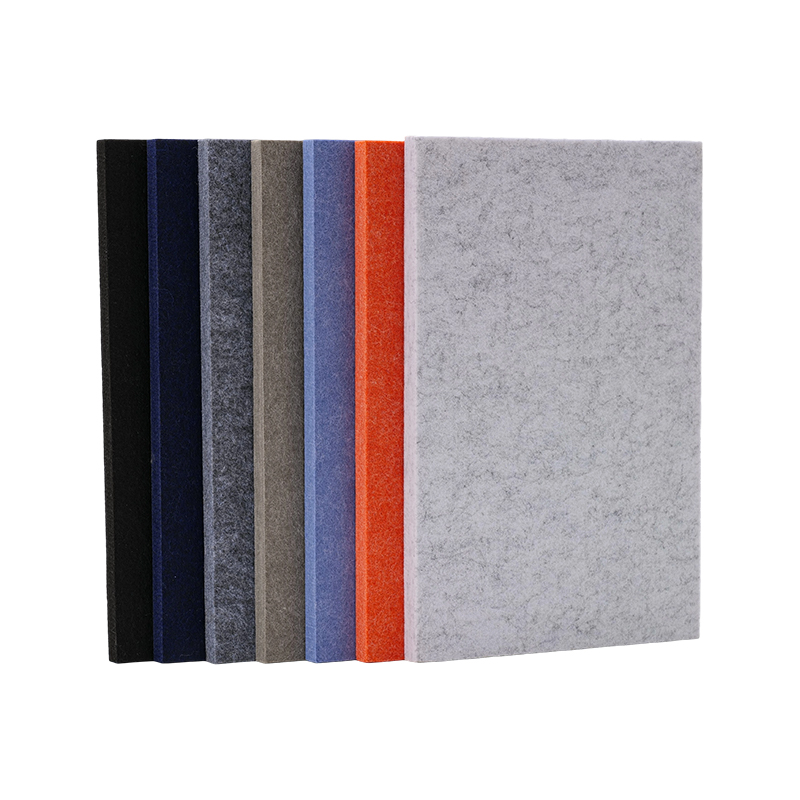 Spesonic High-Density Polyester Fiber Acoustic Wall PanelsHigh-density polyester fiber wall panels for sound absorption, offered in 9 mm and 12 mm thicknesses with customizable colors and low-formaldehyde options.View Product →
Request Indoor Air Quality Evidence With the First Sample
Formaldehyde and VOC documentation is reviewed at tender stage on commercial interiors, and a panel that cannot show an E0 formaldehyde result or a low-emission test report risks substitution before the order is placed.
GB/T 39600-2021 sets E1 at 0.124 mg/m3, E0 at 0.050 mg/m3 and ENF at 0.025 mg/m3 for formaldehyde emission. For projects pursuing LEED v4.1, the Low Emitting Materials credit expects ceiling, wall and insulation products to comply with CDPH Standard Method v1.2, which reports VOC exposure over a 14-day period. Neither document is expensive to obtain while a product is in production; both are impossible to obtain retrospectively if the finished panel was never tested.
Recycled content is a separate question. A polyester felt panel made with a high proportion of post-consumer or post-industrial material can support recycled-content credit claims, but the claim needs a declaration stating the percentage by weight and the boundary used.
Set Coverage and Layout Before the Panel Count Is Fixed
Reverberation control in commercial interiors typically treats 15 to 25 percent of the wall or ceiling area, concentrated at first-reflection points and in the ceiling plane above occupied zones.
Two rooms of identical volume can need different quantities of absorption if one has a glass curtain wall, a stone floor and a 4 m ceiling while the other has carpet, a suspended ceiling and 2.7 m clearance. Work in this order: target reverberation time, absorption area, panel size and fixing detail, then the purchase order.
Placement rules that survive value engineering
- Rear wall behind the meeting table, where the first strong reflection arrives.
- Side walls between 0.8 m and 1.8 m above finished floor, the seated ear height band.
- Ceiling plane above desks where the slab is exposed or the ceiling is hard.
- Balanced treatment on opposite surfaces rather than one fully covered wall.
- Clearance from sprinkler heads, detectors and access panels, checked against MEP drawings before the cutting list is issued.
Where the finish has to read as architecture
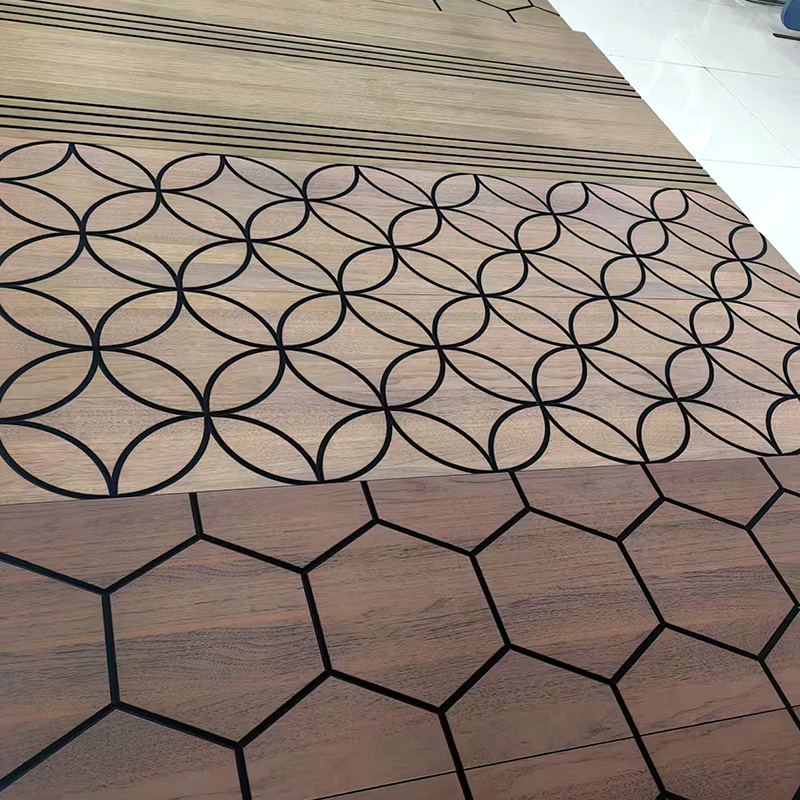
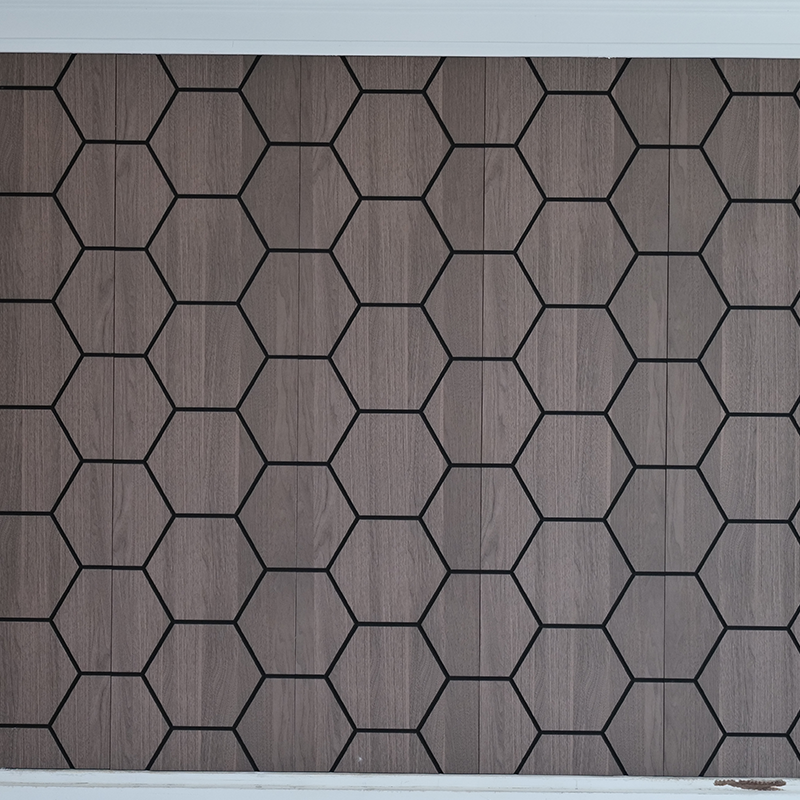
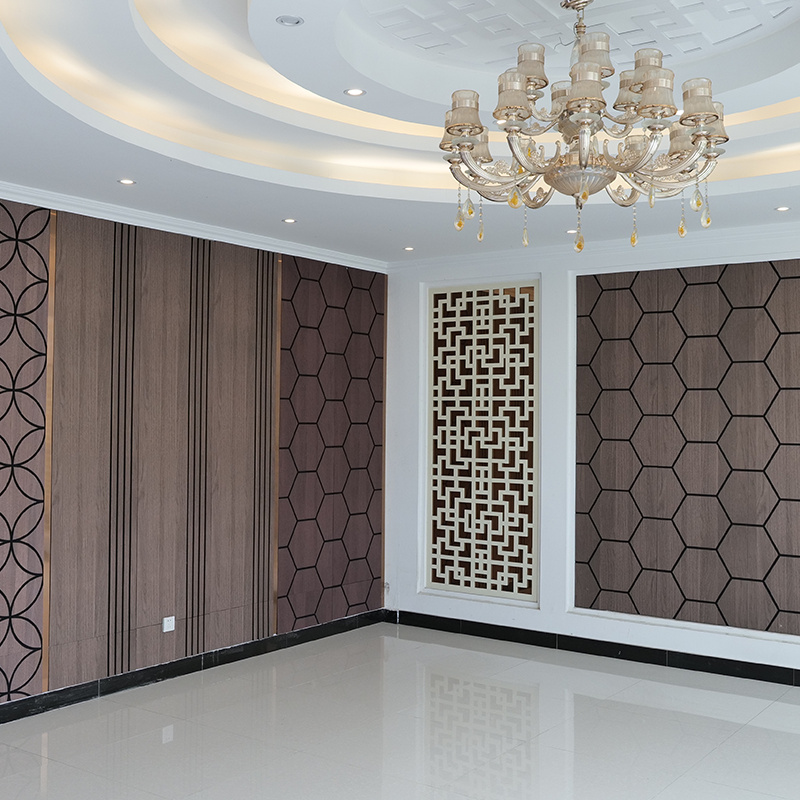
Lobbies, boardrooms and hospitality interiors rarely accept a plain rectangle. Slatted timber systems over a felt backing, fabric-wrapped panels with square or bevelled edges, and printed or heat-transfer murals keep the same absorptive substrate while changing the surface. Confirm that the decorative layer sits inside the fire classification and that colour, pattern repeat and batch were approved on a physical sample rather than a screen image.
 Akupanels Wooden Slat Polyester Fiber Acoustic PanelsSlatted acoustic panels combining recycled polyester felt with wood or MDF slats, suited to decorative, sound-absorbing hotel and office walls.View Product →
Fixing details, including impaling clips, Z-clips, adhesive coverage and baffle suspension, are compared in this guide to acoustic wall panel installation methods. Whichever system is chosen, the fixing must appear in the quotation; a panel rate excluding clips and adhesive is not comparable with one that includes them.
Close the Order With Tolerances, Packing and Spares
A thickness tolerance of 1 mm either way, a batch-matched colour approval on the first article and a 3 to 5 percent spare quantity cover the three most common site rejections on commercial panel orders.
- Sample approval: sign off a production sample at full thickness, seal one unit and keep it on site as the reference.
- Batch control: every panel for a floor from one production batch, with the batch number printed on the packing list.
- Dimensional tolerance: 1 mm on thickness and 2 mm on cut length, plus edge squareness where panels butt without a trim.
- Packing: corner protection, moisture barrier and pallet labels matching the room-by-room cutting list.
- Delivery terms: fixed Incoterms, lead time measured from deposit, and clear allocation of risk for site storage before installation.
- Spares: 3 to 5 percent of each size from the same batch for damage and later changes.
None of this is exotic. It is the difference between a delivery that installs in the planned sequence and a site that stops while a replacement batch is produced, packed and shipped.
The six-point check
Rating matches the problem; test build-up matches the order; fire class matches the code; material matches the fixing; air quality documentation matches the tender; coverage and layout match the room. A supplier who answers all six in writing can be held to the specification, and that is the only acoustic warranty worth having.
Questions That Decide the Order
What NRC should commercial office panels have?
Specify NRC 0.75 or higher for walls and ceilings in open-plan offices and meeting rooms, and check the figure on the thickness you are actually buying. Below 0.70 the treatment usually lowers reverberation without changing speech privacy, because it removes too little energy in the 500 Hz to 2 kHz band.
Is aw better than NRC for European projects?
Yes for specification, because aw to ISO 11654 comes with an absorption class from A to E that a code reviewer can check against a target. Class B, at aw 0.80 to 0.85, is a workable minimum for open-plan offices; NRC remains the standard figure in North American tenders, and both should be backed by one-third-octave data.
Do acoustic panels need an air cavity?
A cavity improves low-frequency absorption and is worth specifying wherever speech intelligibility matters. A 50 mm cavity behind a 24 mm polyester panel moves the working range downward compared with direct fixing on the same wall; confirm the intended fixing in writing before accepting an NRC claim measured on a cavity mounting.
How much spare material should a project order?
Order 3 to 5 percent extra of each panel size from the same production batch. On a 400 square metre order that is 12 to 20 square metres held back, which covers site damage and later partition changes without a colour mismatch between batches.


