


 English
 Español
 عربى
 中文简体



+86-180 3665 1199
Content
- 1 What an Acoustic Lamp Is, and What It Is Not
- 2 Absorption Targets: Thickness, Air Gap, and Ceiling Coverage
- 3 Fire, Formaldehyde, and Certification Requirements
- 4 Fixture Geometry and Room Fit
- 5 Installation, Suspension, and Maintenance Planning
- 6 Cost, Lead Time, and Supplier Verification
- 7 Direct Answers for Specifiers
A 1,800 sq m open-plan floor plate has one ceiling and five claimants: sprinkler drops, supply diffusers, return grilles, the lighting grid, and the acoustic strategy. Specifying an acoustic lamp is how experienced project teams settle that argument, because one fixture delivers task illumination and absorbs the reverberant energy bouncing off the same slab. The complication is that the two halves of that fixture are governed by different codes, tested to different standards, and sourced through different supply chains, which is why acoustic lamps fail submittals on paperwork far more often than on performance.
An acoustic lamp is a luminaire whose housing, canopy, or attached panel is manufactured from a sound-absorbing material, so the fixture lights the room and absorbs mid- and high-frequency sound from the same ceiling position. Most commercial versions use 100% polyester fiber (PET) felt, a needled non-woven board that can be molded, wrapped in fabric, faced with wood veneer or PVC, or left as a plain colored panel.
What an Acoustic Lamp Is, and What It Is Not
An acoustic lamp is a light fixture whose body doubles as a sound absorber, and its acoustic value is set by the absorber's NRC rather than by the light engine, which is why a decorative felt sleeve is not the same product as a purpose-built acoustic luminaire.
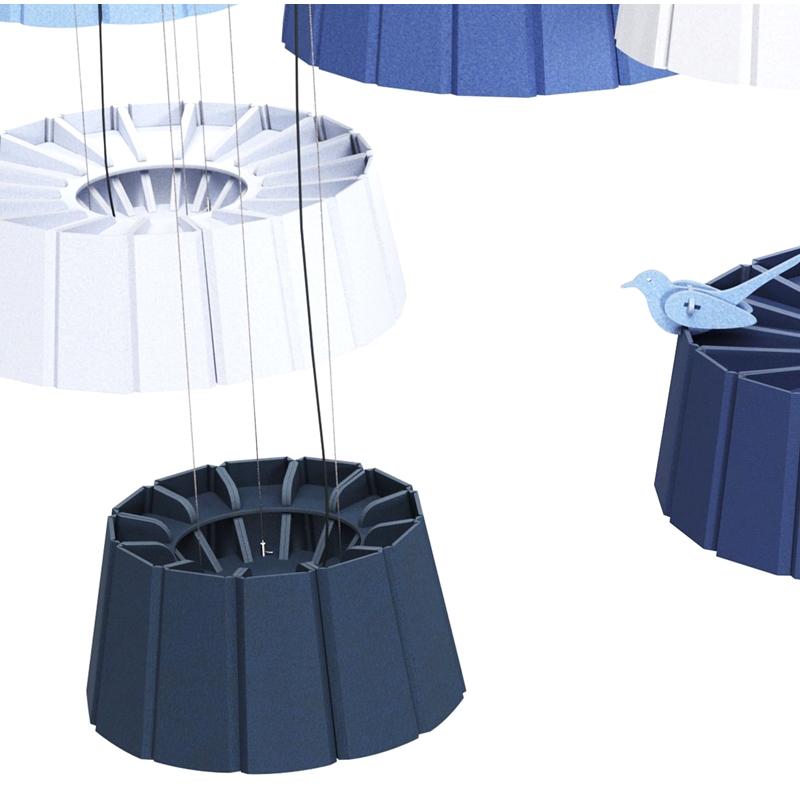
Two product families carry the label. The first is purpose-built: a molded or wrapped felt drum, blade, or canopy with an integrated LED module, normally suspended 400 to 900 mm below the slab so both faces of the absorber stay exposed to the room. The second is a conventional pendant wearing a thin decorative felt sleeve of 3 to 5 mm, which changes the look of a ceiling far more than it changes the way that ceiling sounds.
The gap shows up in the absorption curve. A 12 mm needled PET drum with an internal cavity produces a rising curve across the speech frequencies; a 3 mm sleeve produces a curve that barely separates from the bare pendant underneath. When a value engineering proposal offers a felt sleeve as an equal substitute, ask for both curves measured by the same method and the same mounting condition.
Definition
NRC is the single-number average of sound absorption coefficients measured at 250, 500, 1000, and 2000 Hz to ASTM C423 or ISO 354, expressed on a scale from 0 to 1. An NRC of 0.85 means the surface absorbs 85% of the sound energy that reaches it under those laboratory conditions.
Laboratory values describe one material under one mounting method, so the room remains the final test. The mechanics of how a suspended absorber interrupts echo and flutter in a working office are explained in this guide to how acoustic lamp lighting absorbs sound and echo in real interiors.
Absorption Targets: Thickness, Air Gap, and Ceiling Coverage
For unfaced 100% PET felt, published NRC values climb from roughly 0.35 to 0.45 at 9 mm thickness to 0.85 to 0.95 at 50 mm, so felt thickness is the first variable a specification should lock and the first value any substitution should be judged against.
Typical published NRC ranges for 100% PET felt by thickness
9 mm
0.35-0.45
12 mm
0.45-0.60
24 mm
0.70-0.85
50 mm
0.85-0.95
Ranges reflect manufacturer data published for unfaced needled PET felt. Confirm the actual assembly to ASTM C423 or ISO 354 before issuing a performance specification.
Air gap: the cheapest absorption on the project
A 12 mm board mounted 50 mm off the slab can outperform a thicker board mounted flush at speech frequencies, because the cavity behind the felt works as part of the absorber. Acoustic lamps exploit this by design: a drum or canopy suspended below the ceiling already has a cavity and two exposed faces, so a pendant with moderate felt thickness can move room performance further than the same material bonded flat to a wall.
Coverage ratio: how much ceiling to give up
In open-plan offices targeting a mid-frequency reverberation time of 0.4 to 0.6 seconds between 500 Hz and 2 kHz, acoustic treatment typically needs to cover 15 to 25 percent of the ceiling plane unless walls, floors, and furniture are also absorptive. ISO 3382-3:2022 defines the open-plan metrics that clients use to accept or reject a result, including distraction distance and speech privacy between workstations, and both respond to total absorption rather than to fixture count.
 Vertical PET Acoustic Baffles for Gyms and High CeilingsStrip-shaped polyester fiber baffles reduce reverberation in gyms and high-ceiling spaces, with customizable lengths, thicknesses, and adjustable suspension.View Product →
Absorption is a surface property. Twenty lamps and two hundred lamps of identical NRC do not produce the same room, and no datasheet can tell you which one you have specified.
Fire, Formaldehyde, and Certification Requirements
A commercial acoustic lamp has to clear three separate test regimes before it reaches site: flame spread and smoke development, formaldehyde release, and the documentation that lets a contractor prove both. ASTM E84 Class A, with a flame spread index of 25 or lower and a smoke developed index of 450 or lower, is the baseline for US plenum and high-occupancy ceilings, and EN 13501-1 B-s1,d0 is the comparable European classification.
| Requirement | Standard | Typical target | Why it blocks a submittal |
| Surface burning | ASTM E84 / UL 723 | Class A: flame spread 25 or lower, smoke 450 or lower | Baseline for plenum-rated and high-occupancy ceilings in the US and Canada |
| European reaction to fire | EN 13501-1 | B-s1,d0 | s1 limits smoke production, d0 limits flaming droplets in escape routes |
| Formaldehyde release | GB/T 39600-2021 | E0 grade: 0.050 mg per cubic meter or lower | Indoor air quality review in schools, clinics, and workplace fit-outs |
| Chinese interior fire grade | GB 8624 | B1 for decorative interior panels | Required document for building code submission in mainland China |
| Quality and environmental systems | ISO 9001 / ISO 14001 | Current certificates listing the manufacturing site | Triggers a supplier audit in most public and corporate procurement |
Finishes complicate the file. A printed image, wood veneer, or fabric wrap sits on top of the tested felt and can change the classification, so the finish must be covered by the report or retested as a complete assembly. Teams selecting decorative surfaces will find the trade-offs between appearance, print method, and classification in this overview of custom acoustic panel finishes and fire ratings.
Ask for the test report, not the certificate. A usable report names the specimen, its thickness, its mounting method, and the test date. A one-page certificate that lists a product family without a thickness usually cannot be tied to the fixture you are buying.
Fixture Geometry and Room Fit
Geometry decides where an acoustic lamp belongs: suspended drums and pendants suit open workstations at 2,000 to 2,500 mm above finished floor, linear baffles suit corridors and collaboration zones because both faces remain exposed, and felt canopies suit double-height lobbies where a single pendant cannot add enough surface.
Pendant and drum lamps
Suspended 400 to 900 mm below the slab, with published NRC commonly between 0.55 and 0.85 depending on thickness and cavity depth. Best over workstations, reception desks, and dining areas where downward light matters as much as absorption.
Linear acoustic baffles
Vertical or horizontal blades absorbing on two faces, which produces high surface area per fixture. Best in corridors, meeting rooms, and atria where the ceiling void is shallow and the lighting layer has to stay slim.
Canopies and decorative forms
Large absorber area per unit, including ring and chandelier shapes. Best in lobbies, restaurants, and client-facing spaces where the fixture is expected to work as a design statement and an absorber at once.
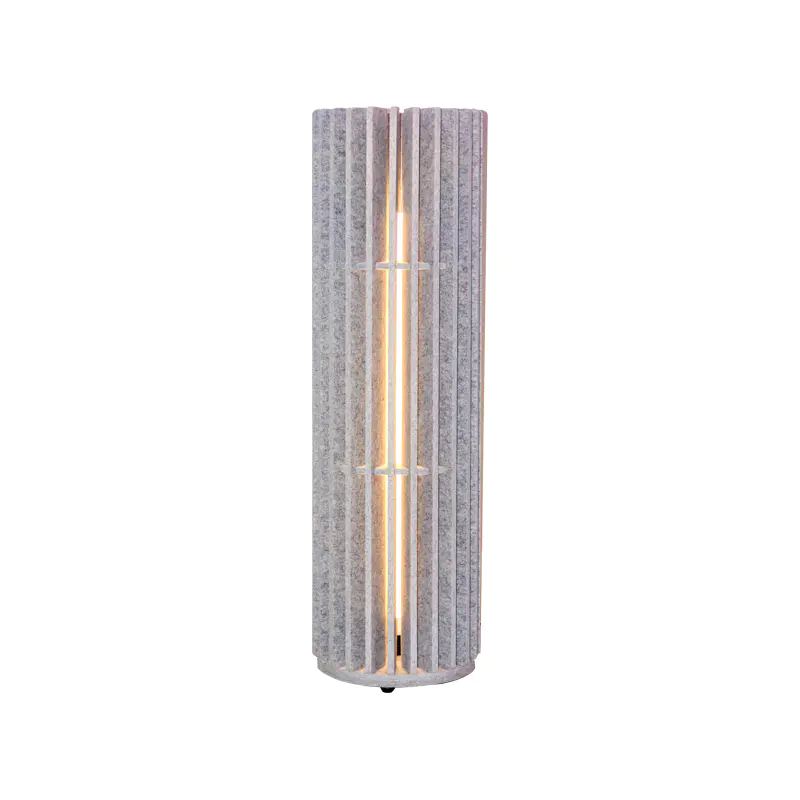 Decorative Sound-Absorbing Chandelier for Offices and LobbiesA factory-direct acoustic pendant combines illumination with noise reduction for cafes, meeting rooms, and hotel lobbies, with custom designs and low MOQ.View Product →
Photometric checks that survive the acoustic trade-off
EN 12464-1:2021 sets a maintained illuminance of 500 lx on the task plane in offices and caps the unified glare rating at UGR 19 for screen-based work, and neither number bends because the housing is made of felt. Thicker housings improve NRC but can cost lumens and raise driver temperature, so request LM-80 data for the LED package, LM-79 results for the complete fixture, and written confirmation that the driver is rated for the ambient temperature inside the felt enclosure.
Installation, Suspension, and Maintenance Planning
Acoustic lamps are installed around service loads and access, not around the visual grid: a 1,200 mm felt drum with a steel canopy adds weight at every suspension point, and any fixture above a fixed ceiling must stay serviceable for driver replacement. Run these five checks before the ceiling grid is released for fabrication.
- Survey the void first. Measure slab to finished ceiling, then map ductwork, cable tray, sprinkler drops, and diffuser brackets. A 400 to 900 mm pendant drop is only available if the void allows it.
- Fix suspension to structure. Use independent hangers or a certified ceiling grid rated for the fixture load, and never hang an acoustic lamp from ductwork, cable tray, or a lighting busway.
- Confirm serviceability. Specify a hinged or removable housing, or a quick-release canopy, so that an LED driver can be replaced without dismantling the absorber.
- Set the cleaning regime. PET felt is maintained with a low-pressure vacuum and a soft brush; saturation with liquid cleaning agents collapses the fiber structure and reduces absorption permanently.
- Coordinate detection and sprinkler layout. Deflector clearances and detector spacing follow local fire code, and a 1,200 mm pendant sitting directly under a detector can delay response time.
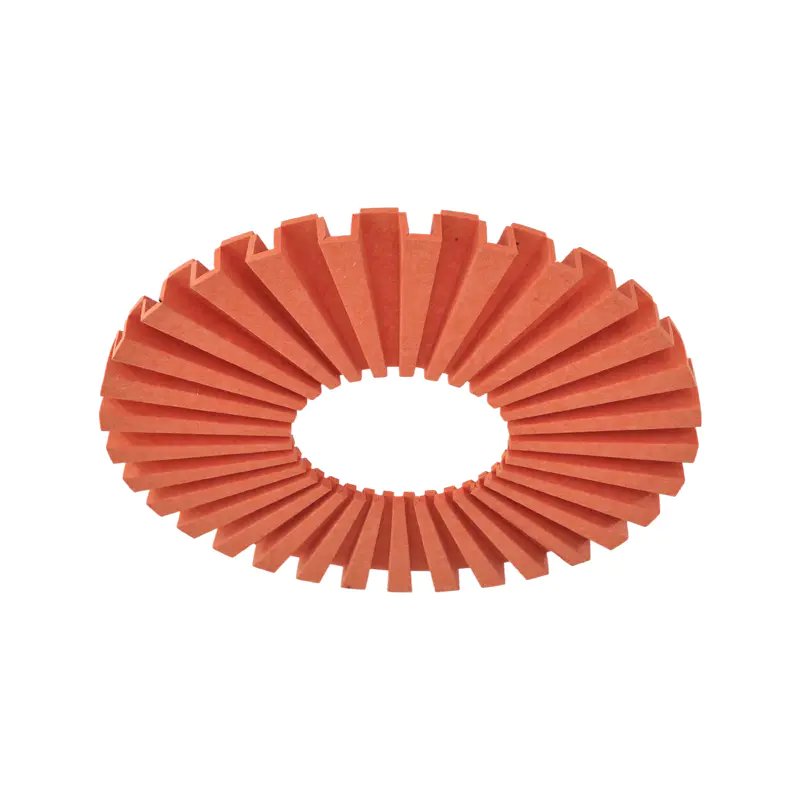 Spesonic PET Hanging Acoustic Ceiling PanelsPolyester fiber suspended panels provide sound absorption for offices, schools, and hospitals, with customizable sizes, 48 colors, and 9 or 12 mm thicknesses.View Product →
On large open floors, suspended felt ceiling panels frequently solve the coverage requirement at lower cost than a high count of small pendants, because absorber area per suspension point is far greater and the ceiling grid carries fewer point loads.
Cost, Lead Time, and Supplier Verification
An acoustic lamp costs more than a standard pendant because two supply chains meet inside one fixture, so budget on a delivered cost per fixture that includes the driver, suspension hardware, and export packing. Factory-direct sourcing shortens that chain but moves more verification work onto the buyer.
30,000+ sq m
Combined production area across three plants, as published by Yayin New Materials Jiangsu Co., Ltd.
NRC 0.85
Absorption coefficient the manufacturer publishes for its polyester fiber board; re-verify it on the finished lamp body.
Class A
ASTM E84 rating published alongside EN 13501-1 B, UL 723-2018 A, and E0 formaldehyde release for the base board.
- Approve a physical sample under the project's own lighting, because PET felt color shifts with color temperature and print method.
- Require the test report to name the felt thickness and mounting method of the fixture being supplied, not the base board alone.
- Confirm suspension loads in writing, including canopy weight, hanger spacing, and the ceiling grid rating the fixture depends on.
- Request driver data: LM-80 for the package, LM-79 for the fixture, and the maximum ambient temperature the driver tolerates inside the felt housing.
- Lock spare parts availability for the driver and the housing, and confirm a 5-year minimum supply commitment in the purchase order.
Direct Answers for Specifiers
What NRC should an office acoustic lamp have?
Specify NRC 0.70 or higher on the fixture body, and match total coverage to the room rather than to the fixture count. A typical open-plan target of 0.4 to 0.6 seconds reverberation between 500 Hz and 2 kHz is normally reached with 15 to 25 percent ceiling coverage when the installed absorbers carry NRC 0.75 to 0.90.
Is an acoustic lamp worth more than a standard pendant plus wall panels?
Yes when the ceiling is the only free absorptive plane. Twenty pendants at 600 mm diameter present roughly 5.6 sq m of absorber face area, and in a fully glazed or heritage-constrained interior the same area cannot be recovered from walls at any reasonable cost.
Do acoustic lamps satisfy fire code for plenum ceilings?
Only when the report matches the fixture. ASTM E84 Class A at flame spread 25 or lower and smoke 450 or lower is the working baseline for US plenum installation, EN 13501-1 B-s1,d0 covers European submittals, and GB 8624 B1 applies to interior decorative panels in China. Fabric wraps and printed finishes usually require separate verification.
When should acoustic lamps be locked into the fit-out programme?
Before the ceiling grid is released for fabrication, which typically means 8 to 12 weeks ahead of installation. Fixture weight, drop length, and canopy size determine the grid design and the sprinkler coordination, so a late change to any of the three forces rework that costs more than the lamps themselves.


