


 English
 Español
 عربى
 中文简体


+86-180 3665 1199
Content
Walk into a restaurant, hotel lobby, or open-plan office and look up. Pendant lampshades hang right in the middle of the space, usually at head height. That layer of the room is where speech and background noise interact the most, yet most standard lampshades are made from metal, glass, or plastic - materials that reflect sound rather than absorb it. The result is a subtle loss of clarity that people often mistake for a general noise problem rather than a fixture problem.
Acoustic lampshade design changes that. A porous material shaped deliberately can reduce reverberation, tame early reflections, and add measurable absorption to the room. This guide explains how form and material work together, and what to specify when speaking to a supplier.
Core concept
An acoustic lampshade is a lighting fixture that uses porous, sound-absorbing material to reduce echo and early reflections while still delivering light.
Why Acoustic Lampshades Matter in Room Acoustics
An acoustic lampshade matters because it places absorbing material in the first reflection zone, where most speech intelligibility is lost.
Most noise control focuses on walls, ceilings, and floors. But the largest sources of early reflections are surfaces close to the listener - including light fixtures that hang at 1.8 to 2.5 meters. Sound waves from a speaker or a group of people hit the lampshade and bounce back into the room. If the shade is hard and curved, it behaves like a small sound mirror.
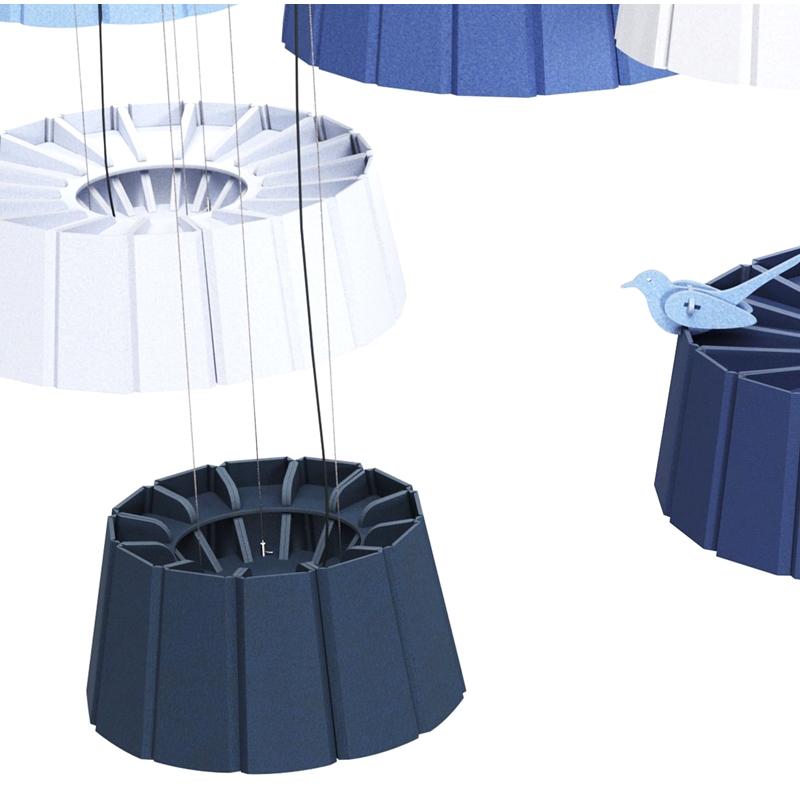
Polyester fiber acoustic lampshades solve this by converting incident sound into heat through viscous friction inside the fiber matrix. A 500mm diameter shade made of 2450 g/m2 PET felt can provide 0.2 to 0.4 Sabins of absorption in the 500 to 2000 Hz range. In a 4x4x3m meeting room with roughly 10 Sabins of total absorption, that is a 2 to 4 percent increase in total absorption. But because the shade sits directly in the path of primary reflections, the perceived improvement in speech clarity is much larger, as documented in the company's research on acoustic lamp lighting that absorbs sound echo.
Key fact The first 50 milliseconds of reflected sound carry more intelligibility weight than the total reverberation tail. An absorptive lampshade in the first reflection zone adds meaningful clarity per square meter of material.
The Role of Material in Sound Absorption
The material determines the absorption coefficient, the fire rating, and the maintenance burden - and polyester fiber felt is the most predictable choice for acoustic lampshades.
Sound absorption in a porous material depends on pore geometry, density, and thickness. Polyester fiber felt made with needle-punching technology creates a dense, interconnected pore structure that absorbs broadband sound. At a density around 2450 g/m2, it reaches an NRC of 0.85 - the same performance grade used in commercial acoustic wall panels.
Fabric-wrapped foam can also work, but foam is less durable and harder to clean. Metal and glass have NRC values near 0.05 to 0.15, essentially reflective. Wood veneer layered over felt is possible, but the wood film reduces absorption unless the surface is perforated.
| Material | NRC Range | Typical Fire Rating | Durability and Maintenance |
| Polyester fiber felt (PET) | 0.80 to 0.95 | ASTM E84 Class A | High, vacuum cleanable |
| Fabric-wrapped foam | 0.55 to 0.85 | Varies, often Class B | Low, tears and moisture damage |
| Metal or glass | 0.05 to 0.15 | Class A | High, no absorption |
| Perforated wood veneer | 0.30 to 0.60 | Class A to B | Medium, needs surface care |
Definition
NRC, or Noise Reduction Coefficient, is the average of absorption coefficients at 250, 500, 1000, and 2000 Hz. An NRC of 0.85 means the material absorbs 85 percent of the sound energy that reaches it in the speech frequencies.
How Form and Geometry Shape Performance
Form is where design intent becomes acoustic reality. The same felt in a flat disc, a cone, or a baffled arrangement produces very different effective absorption.
A flat disc absorbs less than expected because sound must strike the surface at an angle to lose energy. A conical or cylindrical shade increases the exposed surface area per fixture footprint. Adding vertical baffles below the luminaire multiplies the absorbing area even further without increasing the visual mass of the shade.
Flat or shallow shade
Limited exposed area, weak reflection control, best for pendant fixtures with downward-only light.
Curved, conical, or baffled
Larger exposed surface, captures side-angled reflections, popular in hotel lobbies, auditoriums, and open offices.
Effective absorption by lampshade form
Approximate Sabins per fixture at 500 to 2000 Hz.
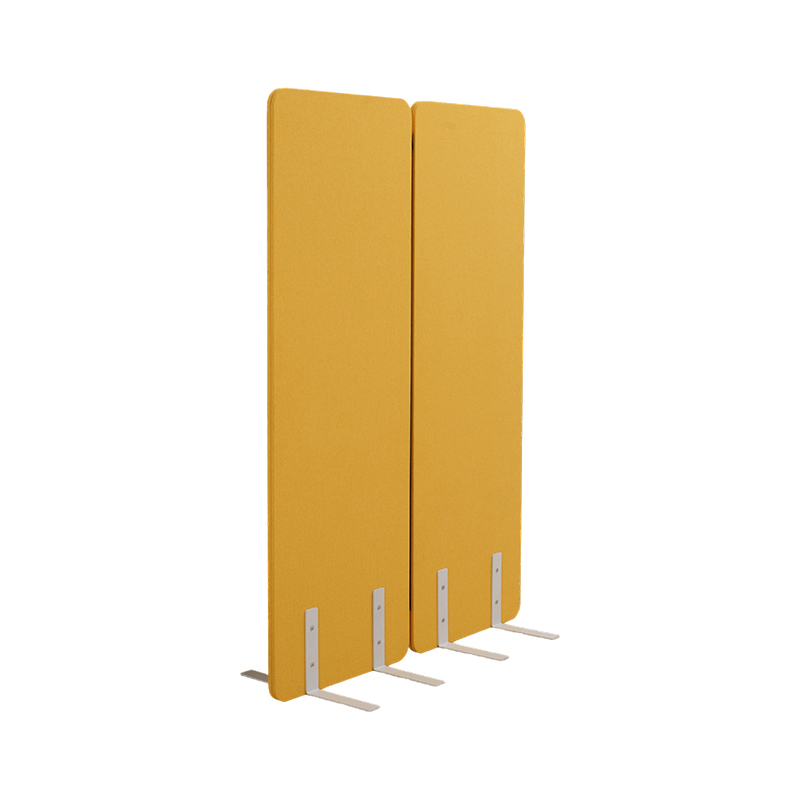
 Strip-Shaped Polyester Fiber Acoustic Baffles for Gym Noise ControlThese strip-shaped polyester fiber baffles increase exposed surface area for effective absorption, suitable for gyms and large open spaces. Factory-direct with custom sizes and fast shipping.View Product →
Design Considerations for Real-World Applications
A lampshade that looks beautiful but fails fire, humidity, or maintenance requirements will be a liability, not an improvement.
Fire safety is the first requirement in a commercial specification. Polyester fiber felt acoustic panels from Yayin New Materials Jiangsu Co., Ltd. can meet ASTM E84 Class A, EN13501-1 B, and UL723-2018 A with E0 formaldehyde emission. Always ask for the actual test certificates rather than generic data sheets.
Humidity is the second issue. Cinemas, bathrooms, and covered outdoor spaces need anti-mold treatment. A hanging acoustic panel with an anti-mold and anti-humidity finish is available for those environments. The heat output from the light source also matters. High-wattage LED drivers generate heat, so the shade needs sufficient clearance from the heat source or a thermal barrier.
- Fire certificate: ASTM E84 Class A, EN13501-1 B, UL723-2018 A
- Moisture: anti-mold finish for cinema and bathroom zones
- Thermal clearance: at least 30mm between LED driver and felt
- Maintenance: vacuum with a soft brush every 3 to 6 months
- Acoustic target: NRC 0.85 or higher for public spaces
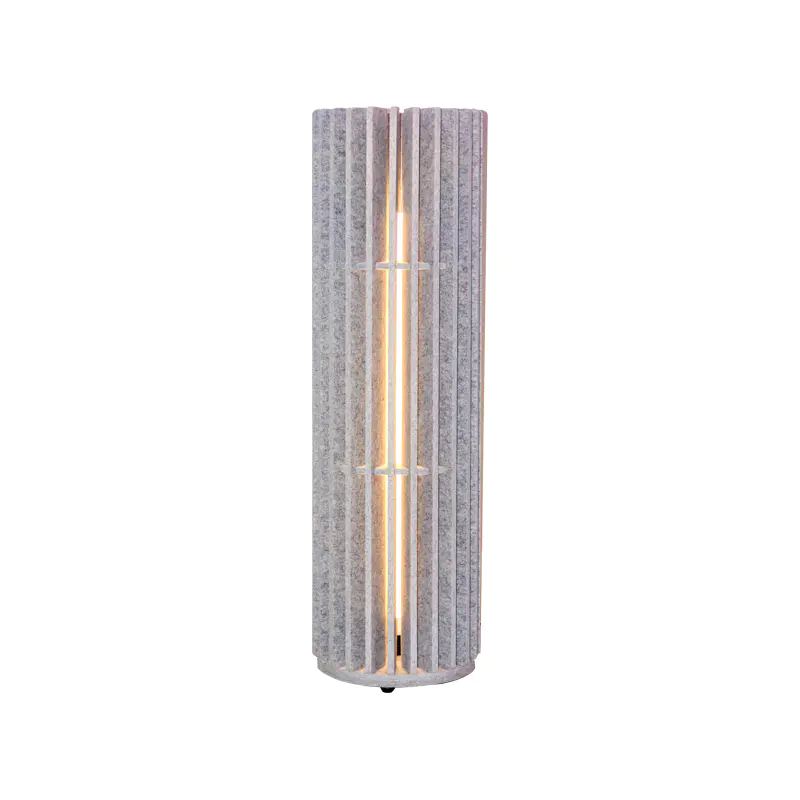 Mildew-Resistant Acoustic Chandelier Ceiling for Humid SpacesThis chandelier-style acoustic ceiling offers mildew and moisture resistance, ideal for cinemas and bathrooms. It meets NRC 0.85, Class A fire rating, and anti-mold treatment for reliable performance.View Product →
Specification priority
Choose a certified felt shade that passes fire and humidity checks first. Then evaluate the geometry against the room's main reflection points. A shade that meets NRC 0.85, Class A fire rating, and anti-mold treatment will outperform a visually striking but acoustically inert fixture.
FAQ
What is the best material for an acoustic lampshade?
Polyester fiber felt with an NRC of 0.85 or higher is the most reliable choice. It combines broadband absorption, Class A fire performance, low formaldehyde emission, and easy maintenance across a long service life.
Do acoustic lampshades reduce light output?
A porous felt shade normally reduces light transmission unless it is designed as a perforated or partially open structure. For a balance between acoustic performance and illumination, look for a shade with at least 40 percent open area or a downward-facing aperture.
What NRC should I look for?
For speech clarity in offices, hotels, or auditoriums, choose an NRC of 0.80 to 0.95. Below 0.60, the shade behaves more like a decorative element than an acoustic device.
Can acoustic lampshades be used in damp environments?
Yes, if the material is treated. A hanging sound-absorbing panel with an anti-mold and anti-humidity finish is designed for cinemas and wet zones. Confirm the moisture resistance rating before installation.


