


 English
 Español
 عربى
عربى
 中文简体
中文简体



+86-180 3665 1199
Content
- 1 1. Acoustic Performance: NRC 0.85 vs. STC Ratings
- 2 2. Lifecycle Flexibility and ROI
- 3 3. Safety, Sustainability, and Material Standards
- 4 Conclusion: The Modular Advantage
- 4.1 Frequently Asked Questions (FAQ)
- 4.1.1 1. How to choose acoustic partitions based on NRC ratings?
- 4.1.2 2. Are Acoustic Office Partitions as fire-safe as drywall?
- 4.1.3 3. What are the benefits of movable acoustic walls regarding tax savings?
- 4.1.4 4. Can customizable acoustic office dividers be used to improve HVAC efficiency?
- 4.1.5 5. Are Yayin panels recyclable polyester office panels truly sustainable?
- 4.2 Industry References
- 4.1 Frequently Asked Questions (FAQ)
In modern architectural acoustics, the decision between modularity and permanence significantly impacts a firm's financial and operational efficiency. When comparing Acoustic Office Partitions to traditional drywall, facility managers must look beyond initial material costs to the Total Cost of Ownership (TCO). Yayin New Materials Jiangsu Co., Ltd., a leader in carbon-neutral polyester fiber antibacterial materials, provides an engineering-grade solution to this dilemma. Operating across 30,000 square meters of production space, we utilize needle-punched non-woven technology to create panels with a noise reduction coefficient NRC of 0.85. This article provides a deep technical dive into the benefits of movable acoustic walls over permanent masonry, focusing on ROI, lifecycle flexibility, and environmental compliance.
1. Acoustic Performance: NRC 0.85 vs. STC Ratings
A common misconception in office design is equating "sound blocking" with "sound absorption." Traditional drywall offers a high Sound Transmission Class (STC), but it reflects sound, leading to high reverberation times. Conversely, high-quality Acoustic Office Partitions are engineered to absorb energy. The noise reduction coefficient NRC of Yayin panels reaches 0.85, meaning 85% of sound energy hitting the panel is absorbed rather than reflected. While drywall requires additional acoustic treatments to manage echo, office soundproofing solutions using polyester panels serve a dual purpose as both a structural divider and an absorber. This acoustic office partitions vs drywall comparison reveals that modular systems provide a more "human-centric" acoustic environment at a lower integrated cost.
Acoustic Engineering Comparison
- Drywall Performance: Excellent at blocking sound between rooms (STC) but poor at internal echo control (NRC ~0.05).
- Polyester Fiber Partitions: Superior at internal noise reduction (NRC 0.85) while providing adequate localized privacy.
| Metric | Permanent Drywall | Acoustic Office Partitions (Yayin) |
| Sound Absorption (NRC) | Low (~0.05 - 0.10) | High (0.85) |
| Reverberation Control | Requires extra panels | Inherent in material |
| Acoustic Privacy | High (Structural) | Focused (Targeted) |
2. Lifecycle Flexibility and ROI
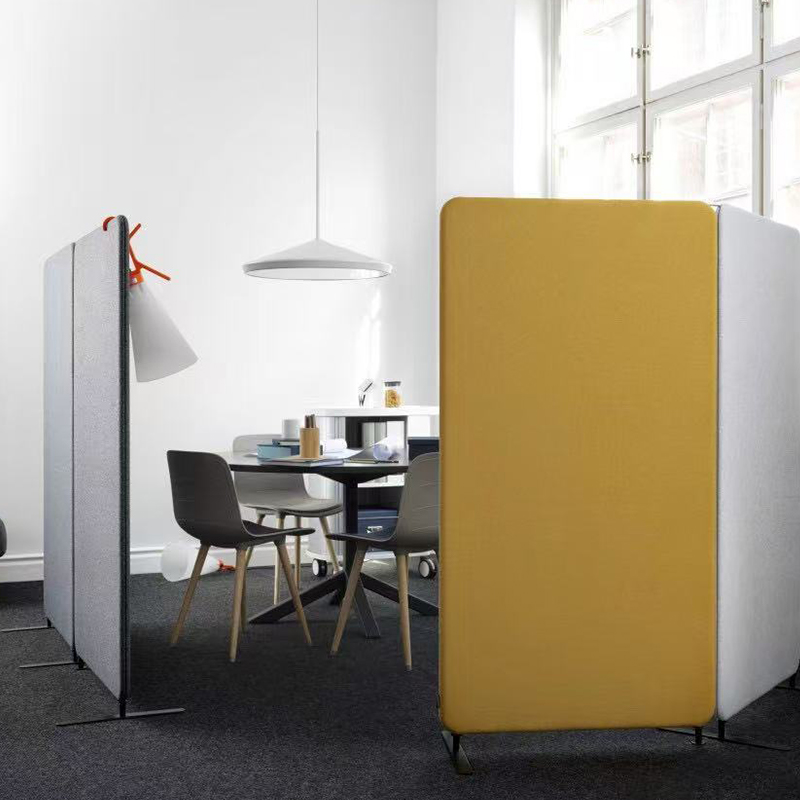
The cost of high-quality acoustic partitions is often higher at the point of purchase, yet the TCO is significantly lower due to "reconfigurability." When a business grows, installing acoustic partitions in open offices takes hours, whereas modifying drywall requires demolition, debris management, and expensive labor. The ROI of acoustic office partitions is realized during the first office layout change; modular systems are 100% reusable, while drywall is a 100% sunk cost. Furthermore, customizable acoustic office dividers allow for aesthetic updates without structural changes. From a tax perspective, modular partitions are often classified as furniture (tangible personal property), allowing for accelerated depreciation compared to permanent 39-year real property improvements.
TCO Sequence for Office Expansion
- Installation: Portable acoustic partitions for offices require no specialized HVAC or electrical permitting for basic layouts.
- Maintenance: Yayin panels are antibacterial and E0-level formaldehyde-free, reducing long-term health-related costs.
- Relocation: Modular units can be moved to new leaseholds, preserving the capital investment.
- Disposal: Drywall contributes to landfill waste; Yayin panels are recyclable polyester office panels, aligning with ESG goals.
| Economic Factor | Permanent Drywall | Acoustic Office Partitions |
| Initial Install Speed | Slow (Weeks) | Fast (Days/Hours) |
| Reusability Rate | 0% | 100% |
| Labor Cost for Changes | High (Skilled trade required) | Low (General facility staff) |
3. Safety, Sustainability, and Material Standards
In high-end corporate environments, the acoustic office partition fire rating is a critical safety benchmark. Drywall is naturally flame-retardant, but many acoustic foams are not. Yayin has engineered polyester materials to meet the A level of the US standard ASTM E84 and the B level of the EU standard EN13501-1. When comparing acoustic partitions for commercial use, the chemical safety profile is also paramount. Our panels achieve E0-level formaldehyde emission, ensuring they do not contribute to Sick Building Syndrome. As eco-friendly acoustic dividers for workplaces, they contribute to LEED and WELL certifications, providing a non-tangible but significant increase in asset value for building owners.
Conclusion: The Modular Advantage
While the initial "sticker price" of permanent drywall may seem attractive, the TCO analysis definitively favors Acoustic Office Partitions. Through superior noise reduction coefficient NRC performance, tax advantages, and the lifecycle benefits of recyclable polyester office panels, modular solutions provide the agility required in today's volatile market. Yayin New Materials Jiangsu Co., Ltd. remains committed to delivering high-precision, carbon-neutral materials that help customers achieve both acoustic excellence and long-term financial success.
Frequently Asked Questions (FAQ)
1. How to choose acoustic partitions based on NRC ratings?
Look for a noise reduction coefficient NRC above 0.80 for open-plan offices. An NRC of 0.85, like Yayin's, ensures that the majority of ambient speech noise is absorbed, significantly reducing the "distraction distance" in the workplace.
2. Are Acoustic Office Partitions as fire-safe as drywall?
Yes. When they meet standards such as ASTM E84 Class A or EN13501-1 Class B, they offer comparable safety for commercial interiors, ensuring that they do not contribute to the spread of flame in an emergency.
3. What are the benefits of movable acoustic walls regarding tax savings?
In many jurisdictions, modular office soundproofing solutions are considered "FF&E" (Furniture, Fixtures, and Equipment), allowing for much faster depreciation schedules than permanent drywall, which is depreciated over decades.
4. Can customizable acoustic office dividers be used to improve HVAC efficiency?
Our panels offer heat-insulating properties. While they don't replace an HVAC system, they help maintain localized thermal zones, potentially reducing energy consumption in large open-plan spaces.
5. Are Yayin panels recyclable polyester office panels truly sustainable?
Yes. They are made from carbon-neutral polyester fibers and utilize needle-punched non-woven technology. Because they are 100% recyclable, they diverted from the waste stream at the end of their lifecycle, unlike gypsum and metal studs.
Industry References
- ASTM E84: Standard Test Method for Surface Burning Characteristics of Building Materials.
- ISO 9001/14001: International standards for quality and environmental management systems.
- EN 13501-1: Fire classification of construction products and building elements.
- Yayin Engineering Technical Sheet: "Comparative Analysis of Polyester NRC vs. Mineral Wool" (2025).


