


 English
 Español
 عربى
 中文简体



+86-180 3665 1199
Content
Install flat 9 mm polyester fiber panels on one wall of a 40 square meter meeting room and the reverberation time drops. Replace them with sculpted panels of the same thickness and the sound field changes again, not because the material differs, but because grooves, carved cells, and stepped edges change how much surface the sound wave can strike, where it penetrates, and where it scatters. For specifiers choosing acoustic wall products, surface geometry is a performance variable, not a decorative extra.
The takeaway: pattern depth and open-area ratio deserve the same specification care as NRC or fire class.
What Sculpted Acoustic Panels Are
Sculpted acoustic panels are porous sound absorbers whose front face has been machined, heat-pressed, or molded into a three-dimensional profile. In a polyester fiber product line, this category includes V-grooved boards, carved 3D tile panels, slotted profiles, and wavy relief boards. Because needle-punched PET felt cuts cleanly under CNC routing, profiles that are impractical on fiberglass or mineral wool, such as sharp edges, deep cells, and thin webs, are standard in a 9 mm or 12 mm board.
Definition
A sculpted acoustic panel is a porous absorber, typically needle-punched recycled PET felt, whose exposed face is profiled so that surface area, edge density, and cavity depth differ from a flat board of the same footprint.
The base material carries the absorption: polyester fiber felt is an open-cell, breathable board that converts sound energy to heat through air friction inside its pores. Surface geometry does not replace that mechanism; it multiplies the area available to sound and adds resonant behavior at chosen depths. For a wider comparison of substrate families, review this guide to sound-absorbing panel materials, types, and performance.
Design rule
Two panels with the same NRC can have different absorption curves. The profile decides where the peak sits, so match the pattern to the problem frequency before comparing single-number ratings.
How Surface Geometry Changes Absorption
Surface geometry changes absorption through four mechanisms: larger exposed area, quarter-wavelength cavity resonance, edge diffraction, and preserved open porosity. Each one can be calculated or observed independently of the material bulk density.
- Exposed surface area. A triangular V-groove with 20 mm spacing and 10 mm depth exposes about 41 percent more surface than a flat face of the same footprint. For any V-groove, the added area equals 2 x sqrt(d^2 + (w/2)^2) / w - 1, where d is depth and w is spacing, so the gain is verifiable from the drawing.
- Quarter-wavelength cavities. A groove 15 mm deep resonates near 5.7 kHz; a 50 mm slot cavity resonates near 1.7 kHz, using 343 m/s divided by four times the depth. Deeper profiles extend usable absorption downward into the mid band.
- Edge diffraction. Every groove edge is a scattering line. Sound bends around edges and enters the porous surface at grazing angles, raising absorption for waves that would otherwise reflect off a flat panel.
- Open porosity. Sculpting keeps the felt face exposed. If the pattern is packed too tightly, closed webs reduce the open area and the panel starts to reflect more above 2 kHz.
Exposed surface area gain for a triangular V-groove at fixed 20 mm spacing. Values are derived from the groove cross-section formula, not from laboratory tests.
Design rule
Keep the open felt face above roughly 50 percent of the panel surface when the goal is broadband absorption; dense patterns trade absorption for visual texture.
Common Surface Geometries Compared
Four production profiles cover most projects: V-groove, carved grid, slotted, and wavy relief. The table below lists the depth range, acoustic contribution, and typical application for each, based on 9-12 mm PET felt panels.
| Geometry | Pattern depth | Acoustic contribution | Typical application |
| V-groove | 6-15 mm | Adds 20-40 percent exposed area; strong absorption between 1 and 4 kHz | Open offices, meeting rooms, corridors |
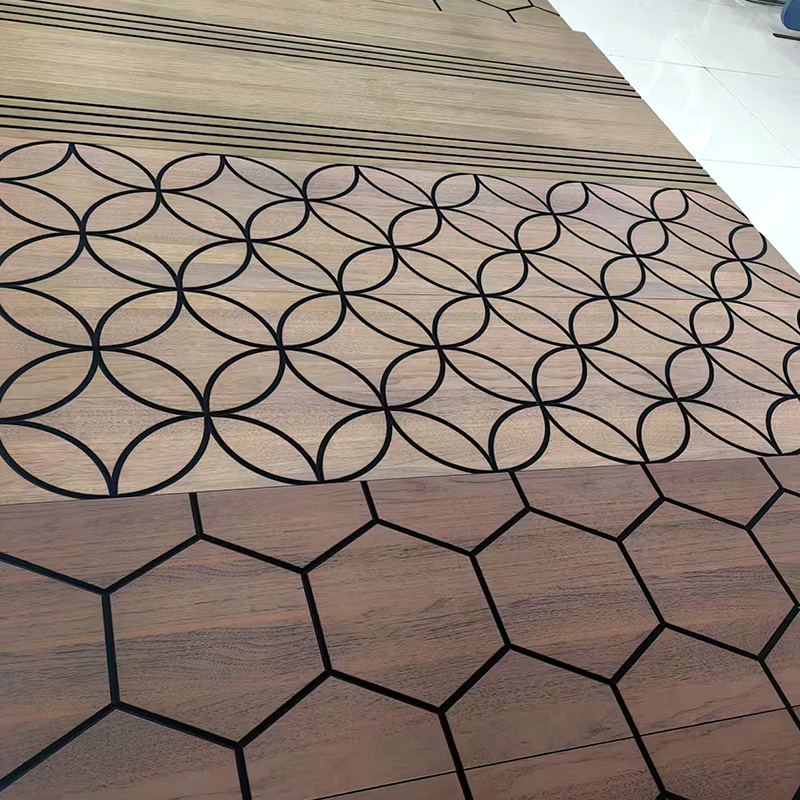
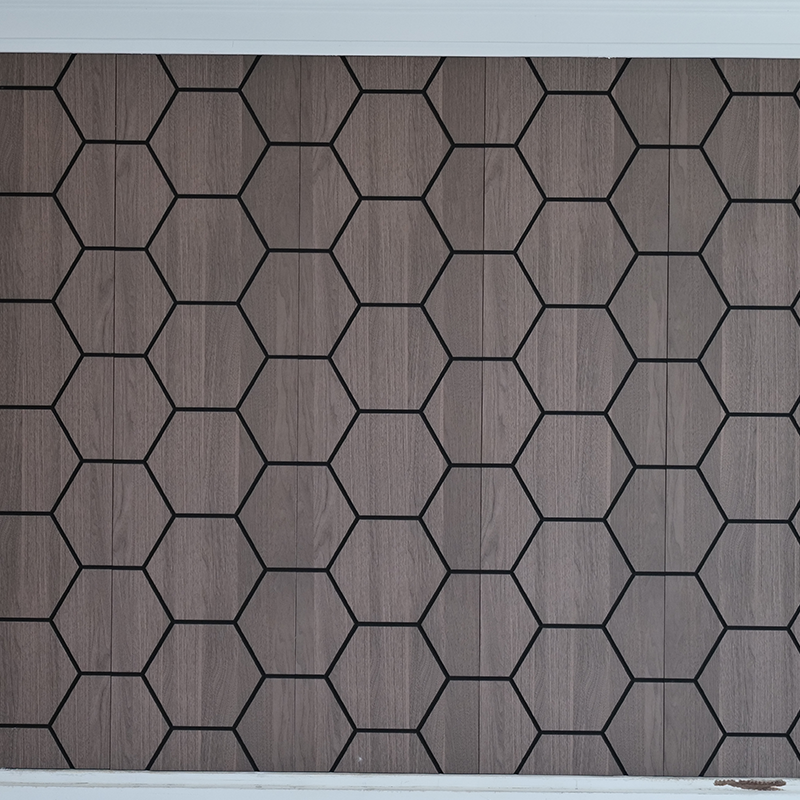
| Carved 3D grid | 8-20 mm | Broad mid-band gain with partial sound scattering | Lobbies, theaters, feature walls |
| Slotted with cavity | 20-50 mm | Extends absorption toward 250-500 Hz | Studios, home theaters, AV rooms |
| Wavy relief | 10-25 mm | Combines absorption with diffusion across the face | Ceilings, stairwells, reception areas |
Groove orientation is mainly an aesthetic and cleaning decision: vertical grooves shed dust more easily, while horizontal channels collect it. Regardless of pattern, leave the porous felt visibly dominant, because patterns that close more than half the face reduce absorption above 2 kHz.
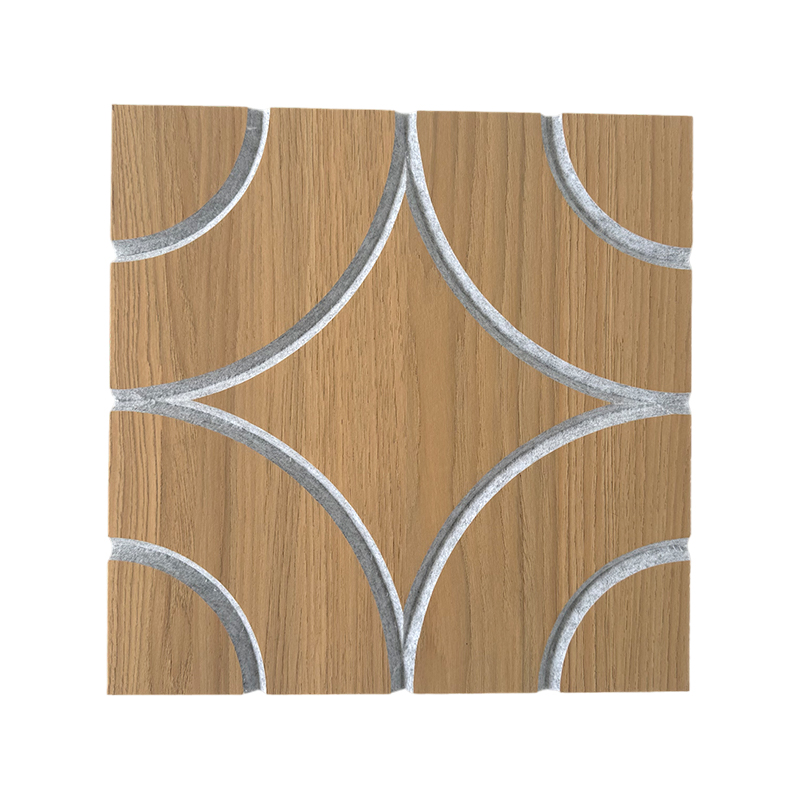
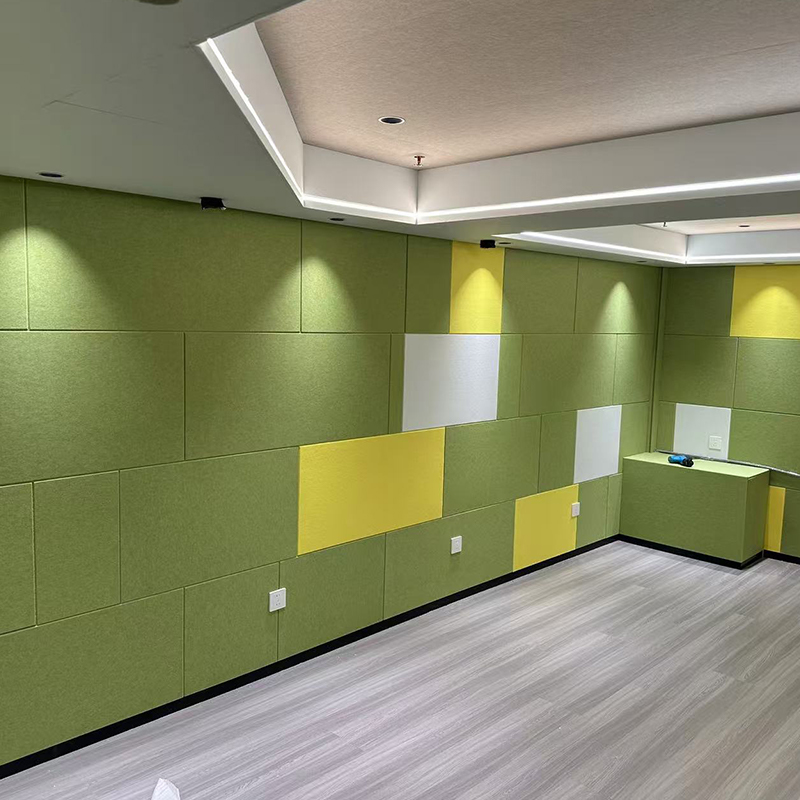 Carved PET Acoustic Panels with Custom Cuts and Verified NRCThese sculpted polyester fiber panels feature carved grooves for aesthetic flexibility and verified acoustic performance, including a 0.85 NRC and Class A fire ratings, making them a reliable choice for sound control and design.View Product →
Performance Data and Standards You Can Specify
Verified performance data is available for the polyester fiber boards used in sculpted panels. Yayin New Materials Jiangsu Co., Ltd. rates its PET acoustic panels at a noise reduction coefficient (NRC) of 0.85, with fire performance meeting ASTM E84 Class A, UL723-2018 Class A, and EN 13501-1 B, and formaldehyde emission at E0 level.
NRC 0.85 Needle-punched PET boards hold Class A fire ratings under ASTM E84 and UL723-2018, meet EN 13501-1 B, and stay at E0 formaldehyde emission while delivering an NRC of 0.85.
NRC is a single average from 250 to 2000 Hz, so it does not show where a panel absorbs best. When the problem is specific, such as voice clarity at 1 kHz or bass buildup at 250 Hz, request the full absorption coefficient table before specifying. Detailed methods for reading these figures are covered in this acoustic panel NRC verification guide.
The substrate is 100 percent recycled PET felt made with needle-punch nonwoven technology. Manufacturing carries ISO 9001 quality management certification, with production across three sites in Jiangsu, Zhejiang, and Jiangxi totaling more than 30,000 square meters.
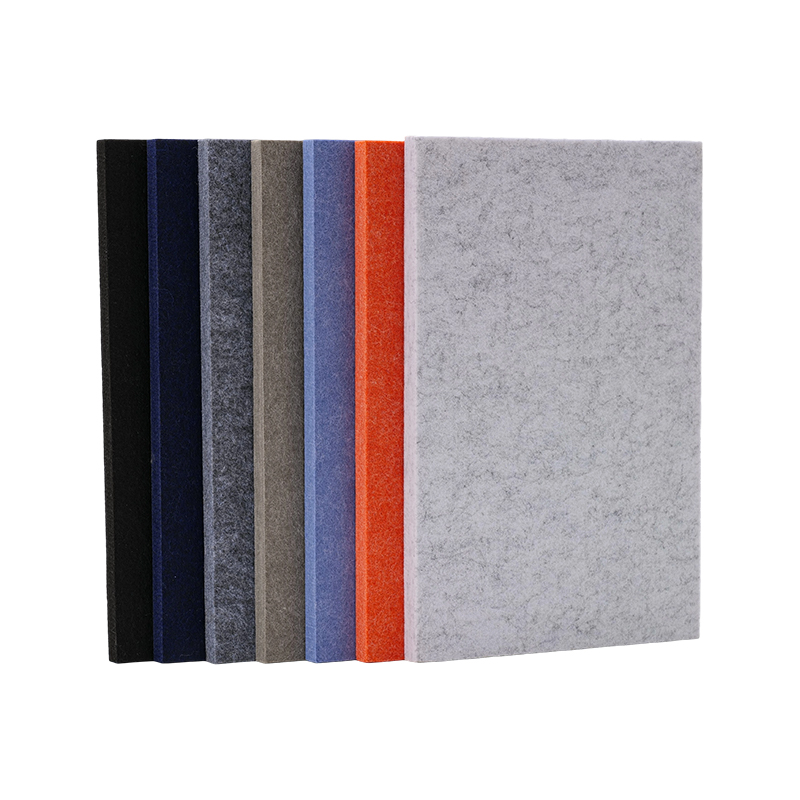
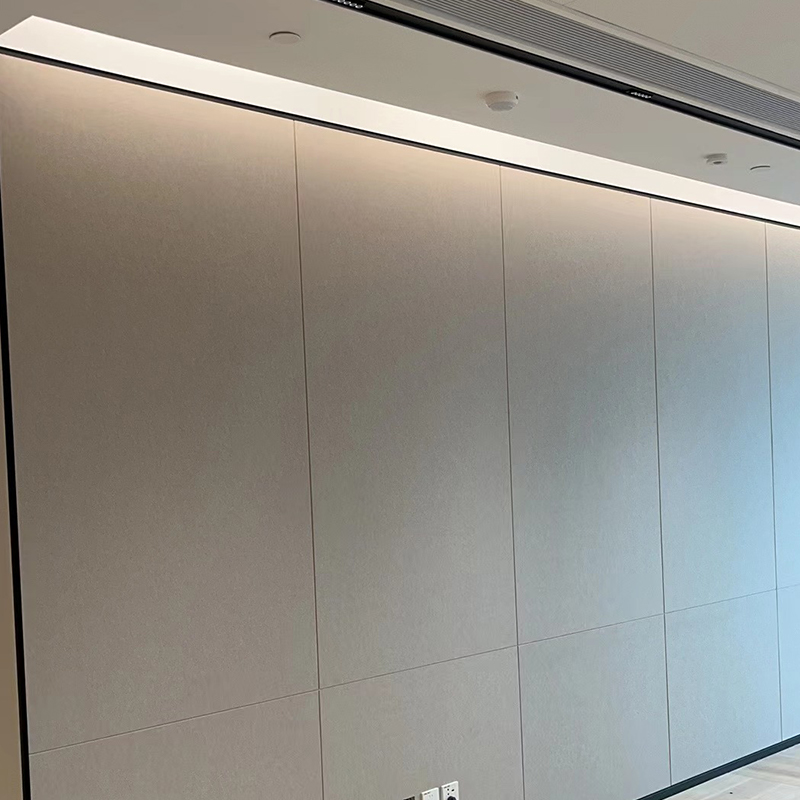 Recycled PET Felt Acoustic Panel with Flame ResistanceMade from 100% recycled PET felt with needle-punch technology, this flat panel offers effective sound absorption at a lower cost per square meter, with easy cutting and cleaning for versatile wall installations.View Product →
Sculpted vs. Flat: Where the Trade-Offs Are
Sculpted panels absorb more per square meter of wall in the mid and high bands; flat panels cost less per square meter, cut faster, and clean easier. Choose based on available wall area and the problem frequency.
Flat PET panels
- Predictable absorption curve set by material density and thickness
- Lower cost per square meter and faster cutting around outlets
- Minimal dust retention on a smooth face
- Absorption scales directly with installed area
Sculpted PET panels
- 20 to 120 percent more exposed surface at the same footprint
- Absorption shifts into the mid and high bands, depending on depth
- Diffusive scattering adds perceived spaciousness
- Decorative value replaces a separate wall treatment
Select flat panels for large-area coverage on a tight budget. Select sculpted panels when wall area is limited, when the design brief calls for a feature wall, or when scattering is needed alongside absorption.
Specifying and Installing Sculpted Panels
Three decisions control the acoustic result: pattern depth, open area ratio, and the air space behind the panel. Address all three before choosing a product code.
- Match depth to the problem band: 6-12 mm V-grooves for speech-range absorption between 500 and 2000 Hz; 20-50 mm slotted profiles when 250 Hz needs help.
- Keep the face open: leave more than half the face as exposed felt; dense carved cells work visually but cost high-frequency absorption.
- Add a mounting cavity for lower frequencies: panels over 25 mm battens gain low-mid absorption compared with direct adhesive mounting.
- Check orientation for maintenance: vertical grooves shed dust during regular cleaning; horizontal channels need vacuum or brush attention.
PET felt panels are light and dimensionally stable, so most profiles can be fixed with construction adhesive or mechanical fasteners. Self-adhesive carved panels suit rented spaces and existing gypsum walls.
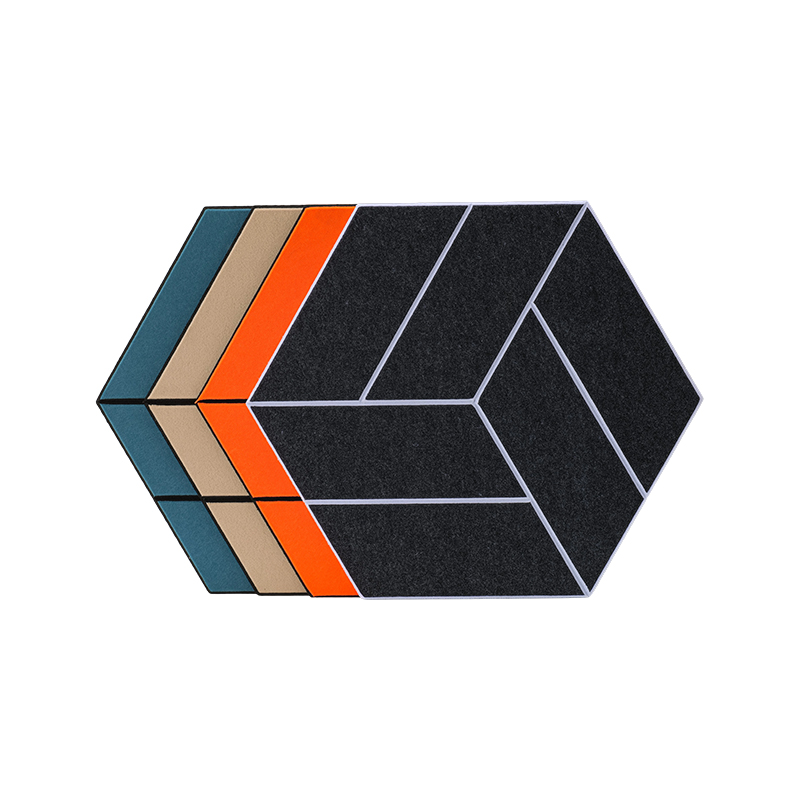 Customizable Grooved PET Sound-Absorbing PanelThis grooved polyester panel allows for custom straight or V-knife cuts, suiting various design needs. It combines sound absorption with mildew, moisture, and fire resistance, ideal for offices, schools, and studios.View Product →
Sculpted Panels: Questions Specifiers Ask
The four questions below cover the calls specifiers make most often.
Do sculpted panels absorb more than flat panels of the same material?
Yes, but the gain is bandwidth-dependent. A V-groove at 20 mm spacing and 10 mm depth adds about 41 percent exposed area and introduces a groove resonance near 5.7 kHz. The clearest gains appear in the 1-4 kHz range; below 250 Hz, add an air cavity rather than deeper carving alone.
What groove depth helps with low-frequency problems?
Use the quarter-wavelength rule: f = 343 / (4 x depth). A 50 mm slot cavity resonates near 1.7 kHz; a 100 mm cavity near 860 Hz. For control below 500 Hz, pair 20-50 mm slotted panels with a 50-100 mm air cavity behind the board.
Which certifications should PET sculpted panels carry for commercial projects?
Specify at minimum ASTM E84 Class A or EN 13501-1 B fire class, E0 formaldehyde emission, and ISO 9001 manufacturing certification. Yayin New Materials Jiangsu Co., Ltd. lists NRC 0.85, UL723-2018 Class A, and a combined factory area exceeding 30,000 square meters across three production sites.
Can carved panels be installed over existing walls?
Yes. PET felt is light and dimensionally stable, and self-adhesive carved panels mount directly onto painted gypsum or concrete. For thicker profiles, use mechanical fixing with washers or mounting rails.


