


 English
 Español
 عربى
 中文简体




+86-180 3665 1199
Content
- 1 What an Acoustic Lamp Actually Does
- 2 What an Acoustic Ceiling Panel Actually Does
- 3 Acoustic Lamp vs Acoustic Ceiling Panel: Key Differences at a Glance
- 4 When an Acoustic Lamp Is the Smarter Choice
- 5 When an Acoustic Ceiling Panel Wins
- 6 The Layered Approach: Why Strong Offices Use Both
- 7 Frequently Asked Questions
Walk onto a 40-desk open-plan floor with a bare concrete soffit and the problem announces itself within minutes: phone calls overlap, instructions get repeated twice, and the room hums long after a conversation ends. Two products keep appearing in the fit-out schedule for that floor, competing for the same budget line. One is a pendant acoustic lamp. The other is an acoustic ceiling panel.
The short version
An acoustic lamp treats sound where people sit; an acoustic ceiling panel treats the room as a whole. Strong office designs specify each for the job it does best.
Acoustic lamp
Absorption at seated height, bundled with lighting. Works over meeting tables and breakout corners.
Acoustic ceiling panel
Absorption across the ceiling plane. Works as the room-wide baseline for reverberation control.
Yayin New Materials Jiangsu Co., Ltd., the acoustic materials manufacturer behind cnacousticpanels.com, makes both families from the same needle-punched polyester fiber felt produced from recyclable polyethylene terephthalate (PET), with panel material tested at a noise reduction coefficient (NRC) of 0.85. The comparison below therefore turns on geometry, installation, and cost, not on which material absorbs better.
What an Acoustic Lamp Actually Does
Definition
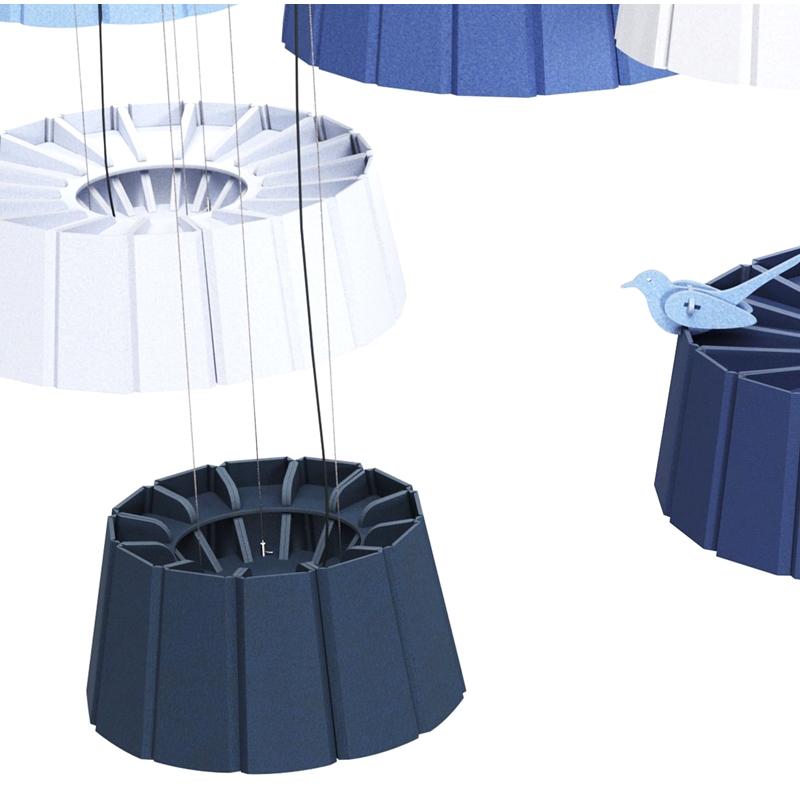
An acoustic lamp is a light fixture whose body or shade is built from sound-absorbing material, most often needle-punched polyester felt, so the fixture reduces echo at seated height at the same time as it lights the space below.
Hung at roughly 2 to 2.5 meters over meeting tables and breakout points, the shade intercepts speech reflections before they travel across the floor. One pendant influences a zone of a few square meters around and beneath it, which makes it a precise, local instrument rather than a room-wide cure.
- Dual function: a single suspension point delivers lighting and absorption together, keeping the ceiling field free for sprinklers, HVAC, and track lighting.
- Design presence: felt shades become the visual anchor of a breakout area and can be colored to match a brand palette.
- Retrofit friendly: only a power drop is required, so occupied floors avoid touching the slab or fire-rated services.
- Limited reach: absorption ends where the shade ends, so a lamp alone cannot rescue a reverberant call center.
The physics behind this hybrid product, and where it fits in a wider acoustic plan, is set out in this guide to acoustic lamp lighting that absorbs sound and echo.
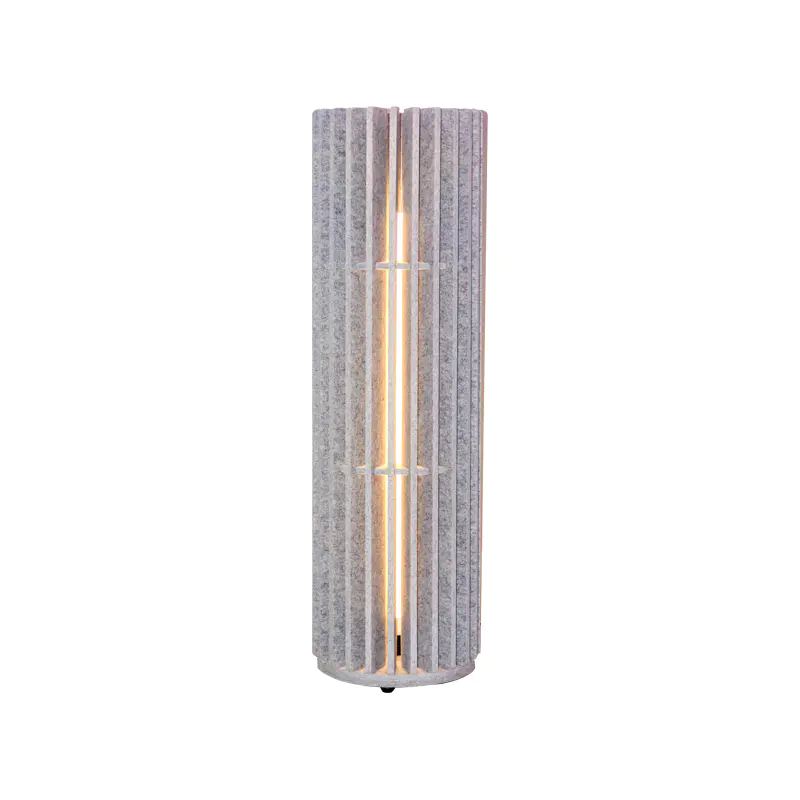 Decorative Chandelier Ceiling Sound-Absorbing LampThis sound-absorbing chandelier combines lighting with acoustic treatment, fitting offices, meeting rooms, and lobbies where ceiling reverberation needs reducing while the room stays stylish.View Product →
What an Acoustic Ceiling Panel Actually Does
Definition
An acoustic ceiling panel is a flat or formed panel of absorptive material fixed to, or suspended just below, the ceiling plane, where it absorbs reflected sound across a wide area of the room.
The ceiling is normally the largest untreated reflector in an office, which is why treating it lowers reverberation everywhere at once: workstations, corridors, phone booths, and meeting rooms all improve from a single installation run. Polyester fiber panels of the type produced by Yayin New Materials absorb about 85 percent of the mid-frequency sound that strikes them, hold Class A ratings under both ASTM E84 and UL723-2018, and reach Class B under EN13501-1.
Suspended versions create a plenum for cabling and air return, and the felt surface can be fabric wrapped, wood veneered, or printed when the interior scheme demands a specific finish.
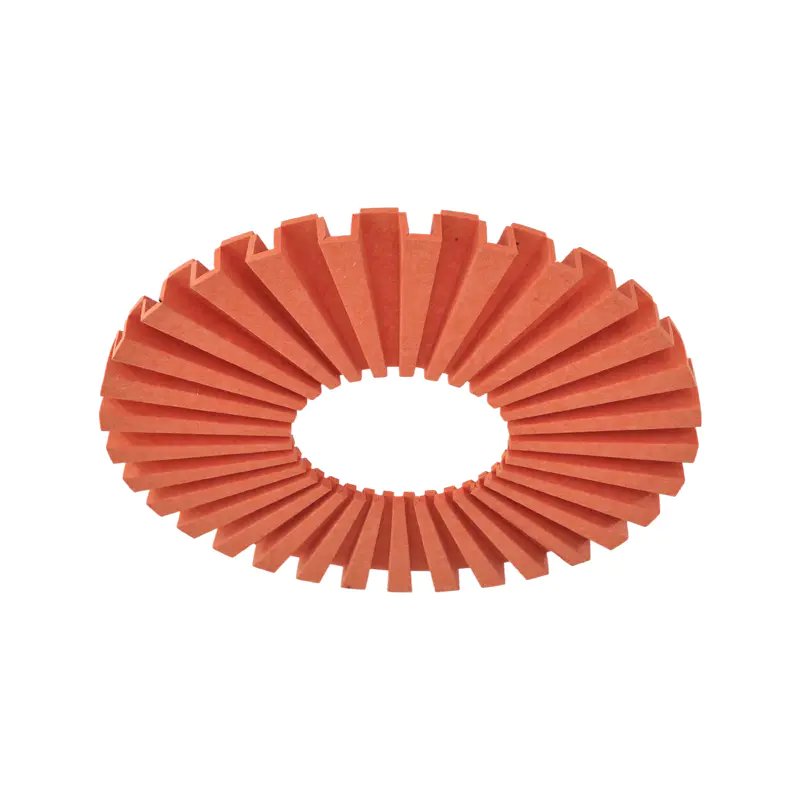 Spesonic PET Hanging Suspended Acoustic Ceiling PanelsSuspended PET panels form a ceiling plane that absorbs sound across the whole room, leaving space above for cabling and air return, with finishes matched to interior schemes.View Product →
Acoustic Lamp vs Acoustic Ceiling Panel: Key Differences at a Glance
The core difference is coverage geometry: a lamp treats a local zone at seated height, while a panel treats the whole room from the top plane down. Everything else in the specification follows from that fact.
| Attribute | Acoustic Lamp | Acoustic Ceiling Panel |
| Primary job | Local absorption plus decorative or task lighting | Room-wide reverberation control |
| Coverage pattern | A few square meters under and around the fixture | The entire ceiling plane |
| Mounting | Power drop and suspension cables | Direct fix, grid mount, or suspended frame |
| Best office zones | Meeting tables, breakout corners, reception desks | Open-plan floors, call centers, training rooms |
| Cost driver | Number of fixtures and wiring runs | Square meters of coverage |
| Design role | Visible feature object | Background acoustic layer |
Treat the two as substitutes and one of two failures follows: panels everywhere under flat, characterless lighting, or beautiful pendants hanging over a room that still echoes.
When an Acoustic Lamp Is the Smarter Choice
Specify the lamp when the acoustic problem is local, or when the ceiling itself is off-limits.
- Leased floors where the landlord prohibits fixings to the soffit.
- Collaboration hubs where the loud spot moves from day to day, so each table cluster deserves its own treatment.
- Reception and client-facing areas that need one strong design gesture with a quiet acoustic side effect.
- Live ceilings already packed with sprinklers, sensors, and lighting track that leave no clean field for panels.
Field note: on occupied retrofit floors, crews hang lamps from existing power drops in a single visit, while a new suspended grid typically puts the floor out of service for the better part of a week.
When an Acoustic Ceiling Panel Wins
Choose panels when the problem is the room itself: overall echo, overlapping calls, and speech that carries from one end of the floor to the other.
Mid-frequency absorption by ceiling surface (NRC)
Exposed concrete0.03
Painted gypsum board0.05
Carpet on slab0.35
PET acoustic panel0.85
Typical published values; the PET figure reflects the tested NRC 0.85 polyester fiber material used across the manufacturer's range.
The numbers explain the economics. Bare concrete returns almost all of the sound that reaches it, so a hard-topped floor stays loud no matter how much soft furniture is added. Panels absorb at the source of most reflections and do so at the lowest cost per treated square meter, particularly when ordered in standard modules direct from the factory.
Why the ceiling plane matters
Absorbing the ceiling is the most cost-effective move in office acoustics, because one surface treats every workstation beneath it.
NRC 0.85Tested absorption
Class AASTM E84 and UL723-2018
Class BEN13501-1 fire rating
E0Formaldehyde emission
Before any order, match the quoted figures against published test data; the specifications behind these ratings are available at cnacousticpanels.com.
The Layered Approach: Why Strong Offices Use Both
High-performing offices rarely choose between the two products; they layer them, with panels setting the reverberation baseline and lamps tuning comfort where teams actually gather.
- Survey the space. Measure reverberation and map the loudest zones before ordering anything.
- Build the baseline. Cover the main ceiling field with panels sized from the survey, not from guesswork.
- Tune the hotspots. Hang acoustic lamps over meeting tables and breakout corners for local absorption and better light.
- Close the vertical gaps. Add desk screens or freestanding partitions between focus rows and talk zones so desk-level noise does not undo the ceiling work.
Where a scheme sits between the two product families, vertical baffles suspended from the slab add absorption without occupying the ceiling field or the floor plan, which is why they frequently appear alongside both in mixed office projects.
 Polyester Fiber Strip Acoustic Baffles for GymsThese strip-shaped vertical baffles add polyester fiber absorption without occupying floor or ceiling fields, making them practical companions to panels and lamps in mixed office projects.View Product →
Panels buy a quiet room. Lamps buy a comfortable table. Projects that specify both spend once and hear the difference every working day.
Frequently Asked Questions
Do acoustic lamps absorb a meaningful amount of sound?
Yes, within limits. The felt body is made from the same polyester material rated at NRC 0.85 in panel form, so per square meter it absorbs as effectively as a panel. The difference is surface area: a lamp presents a small face, so it improves a zone rather than a room.
How much ceiling coverage does an open-plan office need?
Many fit-out teams start by treating 25 to 50 percent of the ceiling plane, prioritizing the field above workstations, then verify the result with a reverberation test before adding lamps or screens.
Yes. Lamps suspend from their own power drops while panels fix to the slab or a grid, so the only coordination task is keeping suspension points clear of panel modules and sprinkler heads.
Which certifications should be checked before ordering?
Ask for the NRC test report, fire classification under ASTM E84, UL723-2018, or EN13501-1, formaldehyde emission at E0, and production under an ISO9001 quality system. Yayin New Materials Jiangsu Co., Ltd. states ratings for each of these across its acoustic product lines.


